
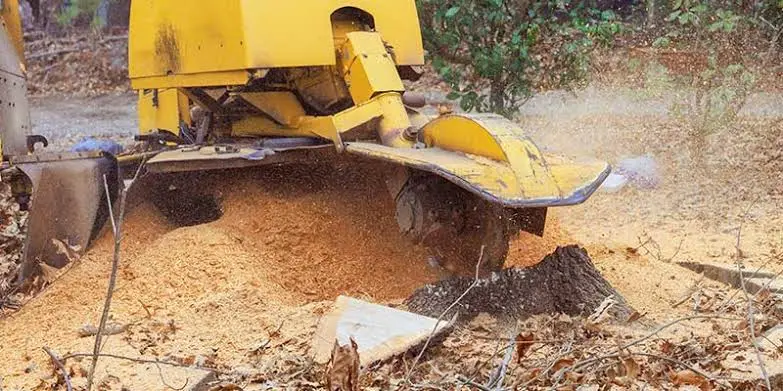
By late August the tree work is finished and the stumps are still there
By late August the summer tree work across much of Canada has been dealt with. The brush has gone through the chipper, and what remains on the lawn is a row of pale stumps nobody planned around. Deciding what happens to them is where a stump grinder enters the conversation.
That conversation is usually shorter than it deserves to be. Most owners ask what it costs to make the stump disappear and stop there. The more useful question is what the ground has to do afterward, because the answer changes method, backfill, and calendar.
Taking out a stump and taking out its roots are two different requests
A stump is the visible remainder of a trunk, but the structure holding it is a root plate spreading past the drip line before tapering into fine roots. Removing wood at and just under the surface is one job. Lifting that plate out is another.
Owners tend to price these as the same errand, and contractors quote them very differently. One is a surface operation measured in an hour of cutting. The other is an excavation involving machine access, spoil handling, and imported fill to close the void.
Excavation buys a clean site and charges for it in disturbance
Digging a stump out delivers the one thing grinding never can, which is an empty hole with no wood in it. That matters when footings, a pool shell, or a driveway base must occupy the ground. Nothing organic remains to decay under the structure.
The price is disturbance. The crater is proportional to the tree, roots of neighboring trees get cut as the bucket works, and buried services often follow the soil the roots followed. A yard outside Barrie lost a cable during a simple removal.
Grinding leaves the root system in place to decay on its own schedule
A stump grinder reduces the visible wood to chips and leaves everything below untouched. That sounds like unfinished work until you consider what a severed root system can do. With no canopy to feed it, soil fungi take it apart over several years.
One exception is worth naming before anyone commits. Poplar, aspen, and black locust push shoots from surviving roots, and grinding does nothing to prevent that. On those species the ground stays busy, and repeated mowing finishes what the wheel started.
How deep the cut goes is decided by what goes on top of it
Depth is less a stump grinder setting than a design decision made before the machine is booked. A lawn asks for enough clearance to hold topsoil and turf roots. A garden bed asks for more, and paving asks for the wood to be gone.
Working that number out first prevents the most common outcome. That is a patch ground just deep enough to look finished and too shallow for the plan. A return visit costs far more than one additional pass on the original day.
The chip pile is a soil amendment with a catch
What a stump grinder produces is not sawdust but a coarse mound of wood chips mixed through with soil. The volume surprises people, because ground wood occupies several times the space the stump did. Raking it level and sowing grass seed is the wrong move.
The problem is not the chips themselves, which are useful material in the right place. It is where they end up and what they do to the soil around them while breaking down. That effect is chemical, and it outlasts a season.
Fresh wood borrows nitrogen before it gives any back
Wood is almost entirely carbon with very little nitrogen, and the microbes decomposing it need both elements. When chips are mixed into soil, those microbes draw the nitrogen they lack from the ground around them. The wood is not taking it permanently, but holding it.
The visible result is a pale, sulking patch exactly where the stump stood while the lawn around it grows normally. Seedlings stall and new grass yellows, so the owner concludes that soil is dead. It recovers as decomposition finishes and the nitrogen returns.
Backfilling with topsoil is what makes the patch behave like ground again
The remedy is to treat the grindings as spoil instead of as fill. Most of the pile is carted off, the hollow is filled with screened topsoil, and a modest fraction of chips is blended back. The remainder works well as surface mulch.
Whatever goes in should sit slightly proud of the surrounding grade, because buried roots keep decaying and the ground above them drops. Sod laid perfectly flush in September is often a visible dish by spring. Planning one top-up next year beats regrading.
Turf can go back within weeks, and a replacement tree cannot
Grass roots occupy only the top few inches. A properly backfilled patch carries seed or sod within weeks of the stump grinder leaving. Late August into September is close to ideal across Canada, with warm soil, cooler air, and dependable moisture ahead.
A new tree is a different request entirely. It needs a wide volume of stable soil, and what remains underground is a decaying mass that keeps collapsing for years. Most arborists suggest planting a few feet to one side rather than waiting out the decay.
What to settle before the wheel starts turning
•Utility locate: buried services follow the same easy soil
•Depth target: set by lawn, bed, or paving
•Spoil plan: chips occupy more room than anyone expects
•Species check: poplar and aspen resprout from surviving roots
None of these questions takes long to answer. Each is cheaper to settle before the machine arrives than after. The list also tends to move the quote, since working depth and spoil removal are the variables with the largest effect on a day of grinding.
Where grinding is the honest answer and where digging is
•Suits: lawns, tight access, roots near buried services
•Suits: keeping neighboring trees and their root plates intact
•Falls short: footings, pool shells, and paved bases
•Falls short: species that resprout from surviving roots
Read as a pair, those lists describe one question rather than two competing products. Grinding is a landscaping decision and excavation is a construction one. Choosing well depends more on the plan for the site than on the diameter of the stump.
Yard renovation is becoming a sequence rather than a single afternoon
Property owners increasingly treat removal, restoration, and replanting as three separate steps with real time between them. That is why the results stop looking like repairs. Municipal replanting programs encourage the same habit, since a young tree given proper soil volume survives better.
That longer view is why the land clearing equipment TMG Industrial supplies gets chosen around what a site has to become, not only around what has to come out.