
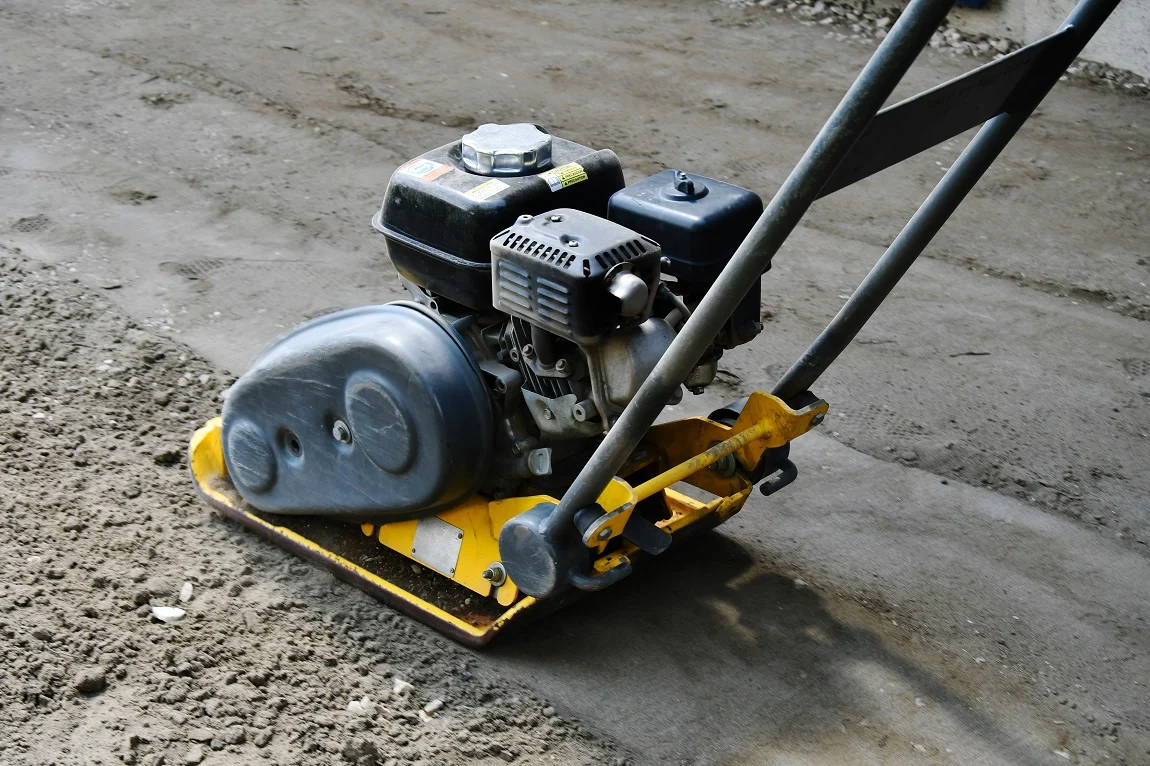
Both machines vibrate, and that is where the similarity ends
American paving and repair work runs until the asphalt plants close for the season. A vibratory roller and a plate compactor are frequently treated as interchangeable at the rental counter, and choosing wrongly produces a surface that fails within a year.
A plate delivers high frequency energy through a flat face pressed against the ground. A roller delivers a smaller amount of vibration underneath a great deal of static weight rolling continuously, which acts on the material in an entirely different way.
Neither is a scaled version of the other. A vibratory roller and a plate are separate tools that happen to share a category, and operations that own both use them on different parts of the same job rather than interchangeably.
Vibratory roller versus plate compactor is a question about the surface as well as the soil
A plate hammers. Every impact leaves a mark, and on granular base that does not matter because nothing is being finished. On an asphalt or a paver surface the same impacts leave a texture that stays visible for the life of the work.
A drum rolls. It applies pressure progressively along a line of contact and leaves the surface it passed over smooth, which is why every finished asphalt surface in the country was compacted by something with a drum rather than a plate.
Static weight does most of the work on a roller
The vibration in a drum assists the static load rather than replacing it. That is why rollers are heavy for their size, and why a 10 horsepower vibratory roller is specified by drum width and machine weight rather than by the force figures that describe a plate.
That also explains why roller weight is quoted so prominently. Two machines with similar vibration figures behave differently if one is substantially heavier, because most of the compacting force is arriving through the frame rather than through the exciter.
Two drums means no tires, and no tires means no scuffing
A machine with a driven rear tire and a front drum turns by dragging rubber across the surface. On fresh asphalt that scuffs and picks up material, which is why double drum machines are used where the finish matters.
Turning is where surfaces get damaged
Any machine pivoting on fresh asphalt tears it, regardless of what it rolls on. Turns are made off the mat, or made gradually while the vibratory roller is moving, and a crew that turns on the patch undoes the compaction it just finished.
Steering also differs. A double drum machine is articulated or steers by drum offset, so both drums track and the whole width gets the same treatment rather than being compacted by one drum and driven over by a tire.
How to compact asphalt patch depends almost entirely on temperature
Hot mix is compactable while it is hot and stops being compactable as it cools. The working window is measured in minutes rather than hours, and material that has dropped below its lower limit will not densify no matter how many passes are run over it.
Ambient temperature and lift thickness both change how long that window lasts. A thin patch on a cool October morning may be uncompactable within minutes of being laid, while the same mix in August gives a crew considerably longer to work.
That makes the sequence unforgiving. Material goes down, is raked to level, and is rolled immediately, and a crew that stops to fetch the machine has usually lost the temperature that made the repair worth doing.
Vibration comes off for the final passes
The first passes use vibration to densify and the last are made static, which closes the surface and removes the marks left by the vibrating drum. A patch rolled with vibration to the end looks textured and lets water in at the top.
Pass pattern matters as much as pass count
Each pass overlaps the last by a portion of the drum width, and the machine works from the outside toward the middle on a crowned surface. Random passes leave strips at different densities, which shows up as a patch that wears unevenly rather than one that fails outright.
Edges are where patches fail, and rollers reach them badly
The joint between new material and the existing surface is the weak line, and it needs to be compacted rather than merely rolled over. Working the drum partly on the old surface and partly on the new is what welds the two together.
Sealing that joint afterward is standard practice on work that has to last. A bituminous sealant run along the edge keeps water out of the one line where the two materials will never bond completely, and it costs very little relative to the repair.
Water on the drums is not optional on asphalt
Hot mix sticks to steel. A water system wetting both drums stops material lifting off the patch, and running dry for even a short stretch pulls a hole in the surface that then has to be repaired again.
Ten horsepower describes a class rather than a capability
This size suits patches, driveways, paths, and trench reinstatement rather than roads. The limit is not power but coverage, since a narrow drum makes many passes to cover an area, and at some size that stops being reasonable.
Transport is part of choosing this class
A machine at this weight goes on a small trailer behind an ordinary vehicle, which is why maintenance crews own them rather than hiring. Anything substantially larger needs a proper plant trailer and a tow vehicle rated for it, and that changes the economics entirely.
Compaction equipment divides by what it finishes
•Plate: base and backfill, leaves impact marks
•Roller: asphalt and finished surfaces, rolls smooth
•Rammer: narrow trenches in cohesive soil
Where a small roller pays and where it does not
•Strength: a closed surface with no plate marks
•Strength: static weight works with the vibration
•Limit: narrow drums need many passes
•Limit: useless once the asphalt has cooled
Weighed against a plate, a roller costs weight and transport and returns a surface that looks and performs like paving rather than like a repair. A maintenance crew in Pennsylvania keeps one on the trailer specifically so nothing waits for a machine while the mix cools.
Small scale paving is being held to a visible standard
Property managers and municipalities increasingly judge a patch on how it looks as well as whether it holds, which has moved finish quality into equipment decisions that used to be made on compaction force alone.
That change in expectations is why the construction equipment TMG Industrial supplies separates machines built to densify base from machines built to finish a surface.