
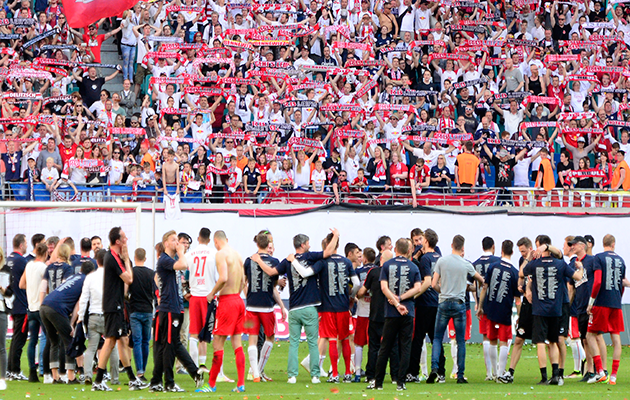
The 2016/17 Bundesliga season combined a high‑scoring reputation with a growing international audience, and that mix heavily influenced how bookmakers and bettors treated big games. In many headline fixtures, markets priced outcomes—especially goal lines and favourites—more off narrative than off process, creating situations where odds were “too high” relative to realistic probabilities. Understanding why this happened, and how to recognise similar patterns, is more important than naming one or two specific matches.
Why it is reasonable to suspect overpriced odds in big Bundesliga games
Bundesliga football in the 2009/10–2018/19 window consistently ranked among Europe’s highest‑scoring top leagues, with a strong emphasis on counterattacks, indirect free‑kick routines and high‑value assisted chances. That structural profile, combined with an average of 2.87 goals per game in 2016/17 (877 goals in 306 matches), reinforced a public perception of “guaranteed goals” in German football. When public perception leans heavily toward action, markets in high‑profile games often swing toward high‑total overs and short prices on attacking favourites, leaving risk‑adjusted value elsewhere.
At the same time, modern over‑2.5 statistics for the Bundesliga show that while the league often posts around 64% of matches over 2.5 goals, this still leaves a large minority of fixtures at two goals or fewer. In big games, expectation and hype can push odds toward a higher‑scoring scenario than the underlying distribution justifies. The core idea—that the market tends to overpay for “spectacle” in marquee Bundesliga fixtures—is reasonable because the league’s genuine attacking profile amplifies narrative bias rather than correcting it.
How the market tends to overreact in marquee matchups
In headline fixtures, odds are shaped not only by models but also by demand. Matches involving Bayern Munich, Borussia Dortmund, or RB Leipzig naturally draw more betting volume and media coverage, and preview pieces frequently frame these clashes around goals and drama. Contemporary examples—for instance, modern previews trumpeting “goals guaranteed” in Bayern–Leipzig meetings with references to average totals over four goals—illustrate how framing leans toward high scoring. This kind of commentary both reflects and reinforces a market tendency to shade prices toward overs and heavy favourites.
The legacy of spectacular games reinforces this bias. The famous 4–5 Bayern win away to Leipzig in 2016/17 became a reference point for “crazy” Bundesliga football, even though it was not representative of a typical match. When rare events become symbolic, markets in later big games can effectively price the highlight reel rather than the typical outcome. The result is that totals lines may sit too high—4.0 or 4.5 when a realistic expectation is nearer 3.2–3.4—and favourite odds may carry less edge because the public is comfortable backing dominant teams at short prices.
Mechanisms that push big-game odds above fair value
The first mechanism is narrative anchoring. Once a league is widely known for high scoring and “no boring games,” bettors approach big fixtures expecting entertainment, and bookmakers must place odds where money will actually balance, not where pure models alone might suggest. Aggregated league‑level over‑2.5 and goal‑per‑game stats, regularly publicised by analytics and betting sites, anchor expectations around high totals for German top‑flight matches. In big games, that anchor can nudge lines above a neutral, model‑driven point.
A second mechanism is selective memory. Spectacular scorelines involving major clubs, like multi‑goal comebacks or 5–goal thrillers, stick in memory far longer than the many 2–0 or 2–1 contests that are actually closer to the median. Highlight packages from seasons around 2016/17 focus on extraordinary attacking outbursts, which convinces casual bettors that “every” big game is wild. The cause‑and‑effect chain runs from highlights → perception of constant chaos → demand for overs and favourite wins → odds shaded to accommodate that demand.
Conditional scenarios: when “overpriced” really applies
The label “overpriced” only makes sense under specific conditions. One common scenario is when totals lines in big fixtures move significantly higher than those in mid‑table games with similar underlying metrics, purely because of brand names and recent headline scorelines. For example, if two top‑half teams with average combined goals around 3.0 per game are priced on a main line of 3.5 or 4.0, while mid‑table sides with similar numbers sit at 2.5 or 3.0, the gap likely reflects narrative rather than purely objective differences.
Another scenario appears when favourite odds in big games stay short despite genuine uncertainty in the matchup. If both teams have strong attacking numbers and a history of competitive head‑to‑heads, but the market holds the away favourite at a very low price largely due to brand power, cautious bettors may judge that the implied win probability is inflated. In both cases, “overpriced” means that the implied probabilities embedded in odds exceed what a model based on goals, chance creation, and defensive strength would justify, not simply that prices look high.
Table: typical big-match pricing biases and their implications
To make the dynamics more concrete, it helps to outline a simple structure of how big‑match markets can drift away from underlying reality. The table below summarises recurring biases in headline Bundesliga fixtures and what they usually mean from a value perspective, based on the league’s high over‑2.5 environment and the way big games are discussed.
| Market area | Typical big-match bias | Underlying driver | Potential value response |
| Main goal line (e.g. 3/3.5) | Set higher than similar mid-table games | Narrative of “goals guaranteed” | Look for unders or alternative lines if models say ~3.0 goals |
| Both Teams to Score (BTTS) | Shorter odds than mid-tier fixtures | Assumption both big attacks will fire | Consider “BTTS – No” in tactical or high-stakes games |
| Favourite moneyline | Shorter than data suggests | Brand weight and public demand | Back underdog or handicap when metrics show smaller gap |
| Alternative overs (4.5, 5.5) | Sometimes aggressively priced | Memory of rare goalfests | Avoid chasing “highlight reel” outcomes at poor prices |
Interpreting this structure, overpriced odds are most likely where narratives and public demand are strongest: high main goal lines, short BTTS prices, and hard‑backed favourites. A disciplined approach asks whether the implied probabilities in these markets are justified by team‑level metrics and game context, rather than accepting that “big game = lots of goals = fair price.”
How a UFABET-style setup can help quantify mispricing
Turning theory into action requires tools and markets that allow nuanced positioning. When you operate in an environment that provides multiple lines, alternative handicaps, and granular totals, it becomes easier to express a contrarian view on big games. From a situational standpoint where a sports betting service such as ufabet168 เข้าสู่ระบบ offers not only standard over/under and full‑time result markets but also alternative goal lines, both‑teams‑to‑score options, and team totals on high‑profile Bundesliga fixtures, a data‑minded bettor can compare these menus against model‑derived probabilities. The analytical edge emerges when your model, grounded in long‑term scoring patterns and recent team form, consistently puts a lower probability on high‑goal or dominant‑favourite outcomes than the odds imply, allowing you to position on unders, handicaps, or cautious side bets instead of following the crowd.
A stepwise approach to evaluating whether a big game is overpriced
Rather than labelling every marquee fixture as mispriced, a structured process focuses on when the market truly runs ahead of the data. Drawing on the known over‑2.5 tendencies of the Bundesliga and the way big matches are marketed, you can work through a short sequence before each high‑profile game.
- Benchmark the teams’ combined goal metrics
Look at each team’s average goals scored and conceded per match over a meaningful sample, and derive an expected total for the game. In a league where the baseline is around 2.8–2.9 goals, see whether that particular matchup logically sits above or below. - Compare model expectation to the main goal line
If your expected total is around 3.0 but the market sits on 3.5/4.0 due mainly to narrative around attacking stars or past thrillers, that is an early sign of a potentially inflated price on high‑goal outcomes. - Check favourite pricing against performance data
Evaluate whether the favourite’s implied win probability matches their underlying metrics, including xG difference, shot volume, and defensive solidity. If head‑to‑head history and recent form show tight games, very short favourite odds may reflect public bias more than real dominance. - Assess game context and stakes
High‑stakes matches—title deciders, Champions League races—can actually dampen scoring if coaches prioritise control over chaos. When narrative still prices “goals guaranteed,” even though incentive structures point to caution, unders or alternative positions can gain appeal.
Working through these steps keeps you grounded in data, forcing you to identify specific gaps between model and price before concluding that any big‑match market is “too high.”
Where the “overpriced big game” idea breaks down
The concept itself has limits. In some Bundesliga big games, the apparent overpricing of high lines is fully justified by the teams’ underlying attacking numbers and tactical styles. Modern over‑2.5 tables show that certain top teams reach figures as high as 90‑plus percent of their games finishing over 2.5, which means that high goal lines in their fixtures are not necessarily inflated. In those cases, accusing the market of overpricing is just another way of expressing discomfort with correct but unappealing odds.
Another failure point is treating anecdotal evidence as a rule. A handful of big games that landed under 2.5 goals despite bullish markets does not prove systematic mispricing; it may simply show normal variance. Comparative league studies highlight that even in high‑scoring competitions, a substantial minority of games end with low totals. Without large‑sample analysis of closing lines versus realised outcomes, it is easy to mistake selective memory for a structural edge and to overestimate how often the market “gets it wrong” in marquee fixtures.
casino online parallels: big-brand events and perceived value
The same dynamics that shape odds in real big games appear in probabilistic environments that simulate football‑style events. Models often boost engagement by emphasising brand‑name teams and “derby” scenarios, and users are drawn to high‑profile matches where the parameters encourage more scoring. In a casino online context that mirrors this behaviour, big‑branding can make certain events feel more attractive or “loaded with goals,” even when the underlying mechanics keep expected values balanced.
Recognising this parallel helps discipline expectations. Whether you are evaluating real 2016/17 Bundesliga big games or simulated clashes in a game environment, the presence of famous clubs and dramatic narratives does not automatically create exploitable value. The core question remains the same: do the probabilities implied by the prices differ from what a sober reading of data and structure would suggest? Only when the answer is yes does the idea of “overpriced big matches” move from story to strategy.
Summary
Big 2016/17 Bundesliga fixtures sat at the crossroads of a genuinely high‑scoring league and a powerful narrative about “guaranteed goals,” a combination that encouraged markets to lean toward high totals and short favourite odds. League‑wide scoring patterns and modern over‑2.5 data make it clear that while many games did justify elevated lines, others were pushed higher by perception rather than pure process. By benchmarking expected goals, comparing them to market lines, and weighing tactical context and stakes, a bettor can distinguish between fairly aggressive prices and genuinely overpriced big games. In both real matches and football‑themed probabilistic setups, the lesson is to treat fame and hype as potential sources of mispricing—but only after the numbers say so.