
5 years ago, the average Vietnamese online gaming portal user had a fairly narrow set of expectations: find the games, deposit, play, withdraw. The portal was a means to an end — a delivery mechanism for the game rather than an experience in its own right. Players tolerated slow loading, clunky interfaces, and opaque withdrawal processes because the alternatives weren’t dramatically better.
That tolerance has eroded. The modern player — shaped by a decade of smartphone adoption, streaming services, social gaming, and app-native design standards — brings a fundamentally different set of expectations to the gaming portal experience. They want sessions that start in seconds, not minutes. They want rewards they can actually understand and use. They want to switch between game formats mid-session without friction. And they want financial transactions to behave the way every other financial app they use already behaves: quickly, predictably, without explanation.
Portals that haven’t kept pace with these shifting preferences are losing players to those that have. GO88 recognized this pattern early and built its reputation partly by meeting players where their expectations had moved rather than where they had been. Hitclub has followed the same logic — adapting its game portal to reflect how modern users actually want to spend their entertainment time, not how they used to.
The Product That Modern Preferences Are Shaping
The Hitclub game portal currently offers 4 categories shaped by how player preferences have evolved: card games (Tiến Lên, Phỏm, Mậu Binh, Poker) for the competitive social gaming preference; jackpot slots with progressive prize mechanics for the variable-outcome seeking preference; live dealer tables for the authenticity preference; and arcade-style mini games for the short-session, always-available preference. Each category exists because a segment of the modern player base has moved in its direction.
Mapping Player Preference Shifts to Hitclub’s Response
The Shift Toward Mobile-Native Experiences
The most consequential preference shift in Vietnamese online gaming over the past several years has been the migration to mobile-native expectations. Players no longer want a desktop experience that also works on mobile — they want an app that was built for mobile from the start, behaves like every other quality app on their phone, and doesn’t betray its web-adapted origins in the way it handles touch input, loading sequences, and background behavior.
Hitclub responded to this shift with a mobile-first development approach rather than a mobile-adaptation approach. The app architecture was built around the interaction patterns of touchscreen users on mid-range Android devices — the dominant hardware in the Vietnamese market. The result is an app that loads within seconds, navigates smoothly between game categories, and maintains session stability during extended use.
Players who have moved beyond tolerating poor mobile experiences recognize this difference immediately. It’s part of why Hitclub’s mobile user base has grown while portals that still feel like adapted desktop products have struggled to retain players who have grown accustomed to better.
The Preference for Shorter, Flexible Sessions
Modern entertainment consumption has shifted toward flexibility. Streaming services introduced the idea that entertainment should be available in any increment — 10 minutes or 3 hours, depending on what the moment allows. Gaming portal players have absorbed this preference and now expect the same flexibility.
Hitclub’s game structure accommodates this explicitly. Arcade-style mini games deliver complete experiences in under 10 minutes — fish shooting titles, crash formats, and similar quick-play options that don’t require a player to commit to a long session to get value from the visit. Card games and live dealer tables serve players who want longer, more immersive sessions. Progressive jackpot slots provide a middle ground — each spin is quick, but the jackpot mechanic rewards extended engagement.
This range isn’t accidental. It reflects a deliberate response to the modern preference for gaming portal experiences that fit around a day rather than requiring a day to be planned around them.
(Session format and game category overview: https://hitclub.cab/)
The Authenticity Preference and the Live Dealer Response
One of the more interesting preference shifts in recent years has been the movement toward authenticity in online gaming experiences. Players who spent years on purely automated games have begun seeking formats that feel less mechanical — where randomness is delivered by a human rather than an algorithm, where there’s a social element to the session, and where the atmosphere is closer to a real table than a software simulation.
Live dealer gaming emerged as the direct response to this preference shift, and Hitclub’s expansion of its live dealer section reflects recognition that this segment of the player base has been growing. Real-time streamed sessions with human dealers, functioning across multiple classic table formats, deliver the authenticity that a growing portion of modern players specifically seek out when choosing between gaming portals.
The preference for authenticity also shows up in how players evaluate promotions — they’ve become skeptical of inflated claims and genuinely responsive to portals that communicate honestly about what’s on offer. Hitclub’s transparent promotion terms are, in part, a response to this preference shift: players who want authentic experiences also want authentic communication.
The Expectation of Financial Reliability Matching Modern App Standards
Modern payment apps — banking applications, digital wallets, peer-to-peer transfer services — have set a behavioral baseline that users now carry into every financial context, including gaming portals. Deposits should reflect immediately. Withdrawals should process within a clearly communicated window. Errors should be explained, not silently applied.
Hitclub’s payment infrastructure reflects an understanding of this elevated baseline. Deposit processing reflects in player balances within minutes, matching the expectation formed by banking apps. Withdrawal timelines are communicated upfront and met consistently — without the unexplained delays that feel jarring to users whose frame of reference is modern fintech behavior.
Where Preference Shifts Are Still Playing Out
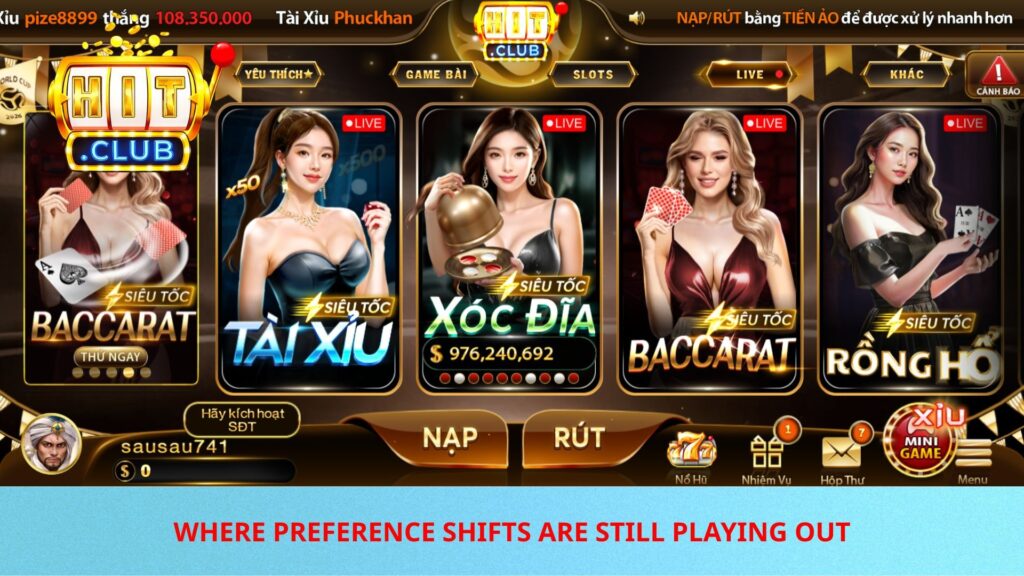
Not all preference shifts have been fully addressed across the market. Modern users increasingly expect personalization — game recommendations based on play history, promotions tailored to actual gaming preferences rather than generic offers, and UI customization options that let players organize their experience around the categories they actually use.
Hitclub’s current portal offers limited personalization relative to what players accustomed to app-native personalization might expect. Daily promotions are broadly structured rather than individually tailored. Game discovery within the catalog is organized by category rather than by individual preference signals.
This is an area where player expectations are ahead of current implementation — not just at Hitclub, but across most gaming portals in the Vietnamese market. The portals that close this gap first will have a meaningful advantage with the next generation of players, who will bring even stronger personalization expectations shaped by their experience with other digital products.
Conclusion
Hitclub’s relationship with changing player preferences is a story of adaptation. The shift to mobile-native expectations prompted a structural rebuild of the app. The preference for flexible, variable-length sessions shaped the game catalog structure. The authenticity preference drove the expansion of the live dealer section.
And the elevated expectation for financial reliability — imported from modern fintech standards — is reflected in payment infrastructure that behaves the way contemporary users expect. The preference shifts that are still playing out — particularly around personalization — represent the next phase of adaptation. For a reward gaming portal that has shown a consistent pattern of responding to where its players are moving, that next phase is a matter of when, not whether.