

Image: Roman Bozhko / Wikimedia Commons (CC0)
Taxes rarely sink a small business because the owner refused to pay. They cause trouble because a deadline slipped past during a busy month, a penalty quietly accrued, and the bill arrived bigger than expected. Unlike employees, whose taxes are withheld automatically, business owners are responsible for tracking and paying throughout the year. That makes the calendar just as important as the amount.
The calendar below organizes the main U.S. federal tax deadlines most small businesses face into four quarters, plus the rolling obligations that do not fit neatly into a single date. It focuses on calendar-year businesses. When a deadline falls on a weekend or legal holiday, it generally moves to the next business day, and the IRS sometimes extends deadlines for taxpayers affected by disasters. State and local deadlines vary, so add them to your own version and confirm details with a tax professional.
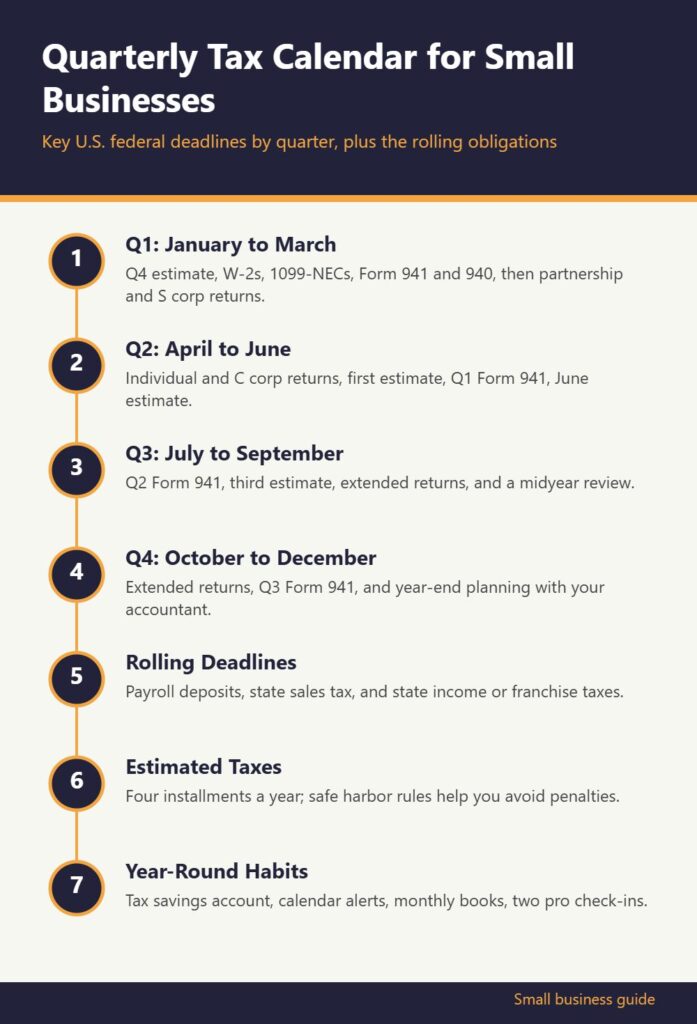
Quarter 1 (January to March): Close the Old Year, Start the New
The first quarter is the busiest of the year for paperwork, because you are wrapping up the previous year while starting estimated payments for the new one.
Mid-January: fourth-quarter estimated tax payment. If you pay estimated taxes, the final installment for the previous tax year is typically due around January 15. Sole proprietors, partners, and S corporation shareholders who expect to owe tax not covered by withholding usually make these payments.
End of January: information returns and payroll filings. Several important deadlines cluster around January 31:
- Form W-2 copies go to employees and are filed with the Social Security Administration.
- Form 1099-NEC goes to independent contractors you paid above the reporting threshold, and is filed with the IRS.
- Form 941, the quarterly federal payroll tax return, is due for the fourth quarter.
- Form 940, the annual federal unemployment tax return, is generally due.
This is why collecting a Form W-9 from every contractor before you pay them matters. Chasing taxpayer identification numbers in late January is stressful and avoidable.
Mid-March: partnership and S corporation returns. For calendar-year businesses, partnership returns and S corporation returns are generally due around March 15, along with the statements that show each owner’s share of income. Owners need those statements to file their personal returns, so this deadline arrives before the individual one. Extensions are available, but they extend the time to file, not necessarily the time to pay any tax owed.
Quarter 2 (April to June): The Big Filing Month and Two Payments
Mid-April: individual returns, C corporation returns, and the first estimated payment. April 15 is usually the most important date on the calendar. It is commonly the deadline for:
- Individual income tax returns, which include Schedule C for sole proprietors and single-member LLCs taxed that way.
- Calendar-year C corporation returns.
- The first estimated tax payment for the current year.
That combination catches many owners off guard: they may owe a balance for last year and a first estimated payment for this year at the same time. Planning for both is one of the most useful things you can do in the first quarter.
End of April: first-quarter payroll return. Form 941 for January through March is generally due at the end of April.
Mid-June: second estimated tax payment. The second installment typically falls around June 15, only two months after the first. Because the gap is shorter than the others, it is easy to be caught without cash set aside. Mark it clearly.
Quarter 3 (July to September): Midyear Check and Extended Returns
End of July: second-quarter payroll return. Form 941 covering April through June is generally due at the end of July.
Mid-September: third estimated payment and extended business returns. Around September 15, two things usually happen. The third estimated tax payment is due, and partnerships and S corporations that filed an extension in March typically must file their returns by this date.
The third quarter is also the ideal time for a midyear tax review. By now you have six to eight months of actual numbers. Compare your profit so far with what you projected when you set your estimated payments. If business is much stronger than expected, increasing your remaining payments can prevent a painful balance due in April. If it is weaker, you may be able to reduce them. GrowBizLab publishes practical walkthroughs on calculating estimated taxes and reviewing them midyear, and its full guide on estimated payments walks through the common methods step by step.
Quarter 4 (October to December): Extended Individual Returns and Year-End Planning
Mid-October: extended individual and C corporation returns. Individuals who filed an extension in April typically must file by around October 15. Calendar-year C corporations that extended generally have a deadline in October as well.
End of October: third-quarter payroll return. Form 941 covering July through September is generally due at the end of October.
November and December: year-end planning. There are usually no major federal filing deadlines in these months, which makes them the best time to plan. Common year-end tasks include:
- Reviewing profit for the year with your accountant and estimating the final tax bill.
- Deciding whether to make planned equipment purchases before or after year-end, based on tax and cash flow considerations.
- Contributing to retirement plans, where deadlines and rules vary by plan type.
- Collecting W-9 forms from any contractors you have not yet documented.
- Cleaning up your books so January’s filings go smoothly.
Avoid making purchases purely for a deduction. Spending a dollar to save a fraction of a dollar in tax only makes sense if you needed the item anyway.
Rolling Deadlines: Payroll Deposits and Sales Tax
Some of the most important obligations do not follow the quarterly rhythm at all.
Payroll tax deposits. If you have employees, the income tax you withhold from their paychecks, plus Social Security and Medicare taxes, must be deposited with the IRS on a schedule that depends on the size of your payroll. Many small employers deposit monthly, while larger ones deposit semiweekly. The quarterly Form 941 reports these deposits; it does not replace them. Payroll software and payroll providers can handle deposits automatically, which is one of the strongest arguments for using them.
Sales tax. Sales tax is governed by states and sometimes localities, not the federal government. Depending on where you sell and how much, you may need to file monthly, quarterly, or annually. Online sellers may have obligations in states where they have no physical presence once they cross that state’s economic thresholds. Sales tax you collect belongs to the state, so keep it separate from operating cash.
State income and franchise taxes. Many states have their own estimated payment schedules, annual report deadlines, and franchise taxes. Some line up with federal dates; others do not. If you are building your first state-by-state checklist, GrowBizLab’s tax and finance articles are a useful resource for understanding which kinds of obligations to look for before you confirm the specifics with your state revenue department.
How Estimated Taxes Work in Brief
Estimated taxes cause more confusion than any other part of the calendar, so a quick primer helps. If you expect to owe a meaningful amount of federal tax that is not covered by withholding, the IRS generally expects you to pay during the year in four installments. Falling short can trigger an underpayment penalty, calculated much like interest.
There are “safe harbor” rules that let you avoid the penalty by paying a certain percentage of either the current year’s tax or the previous year’s tax, with different thresholds for higher-income taxpayers. The exact percentages and thresholds are best confirmed with the IRS or your accountant for your situation, but the principle is useful: basing payments on last year’s tax gives you a predictable target even when this year’s income is uncertain.
A Note for Fiscal-Year Businesses
Everything above assumes your tax year matches the calendar year, which is true for most small businesses and required for many. Some corporations and certain other entities use a fiscal year that ends in a different month. For them, return due dates and estimated payment dates shift relative to the end of their own tax year, while payroll filings such as Form 941 and W-2s still follow the calendar. If your business uses a fiscal year, build your calendar from your year-end date and have your accountant confirm each deadline once so you can reuse the schedule every year.
Building Habits That Make the Calendar Easy
A tax calendar works only if you can afford the payments when they arrive. These habits make that far more likely:
- Open a dedicated tax savings account. Move a set percentage of every deposit into it. Ask your accountant what percentage fits your income and structure.
- Put every deadline in your calendar with reminders. Set alerts two weeks and two days ahead.
- Reconcile your books monthly. Accurate numbers make estimated payments and year-end planning far easier.
- Use the IRS’s electronic payment options. Paying online gives you confirmation and avoids mail delays.
- Schedule two check-ins a year with a tax professional. One in late summer for a midyear review and one before year-end for planning.
- Keep records organized. Store receipts, invoices, bank statements, and filed returns in one place, organized by year.
Common Tax Calendar Mistakes
- Forgetting the June payment. It comes only two months after April and catches many owners short.
- Treating an extension as more time to pay. Extensions generally cover filing, not payment.
- Using withheld payroll or collected sales tax for operations. This money belongs to the government and misuse can carry serious consequences.
- Skipping W-9s. Missing contractor information makes January’s 1099 deadline much harder.
- Ignoring state deadlines. Federal compliance does not mean state compliance.
A tax calendar turns a year of scattered obligations into a predictable routine. Once the dates are in your calendar, money is set aside automatically, and you meet with a professional at the right moments, taxes stop being a source of seasonal panic and become just another scheduled part of running the business.