
The 2011/2012 Premier League campaign served as a crucial evolutionary bridge for modern tactical systems, marked by the increasing adoption of aggressive, high-pressing defensive structures. Long before terms like “gegenpressing” became mainstream jargon, forward-thinking managers recognized that forcing turnovers high up the pitch was the most efficient way to disrupt organized low-blocks. This tactical shift had a profound secondary impact on peripheral statistical markets that casual observers routinely overlooked. By trapping opponents deep inside their own defensive third, these high-pressing sides did not just create high-quality goalscoring chances; they mechanically generated an exceptionally high volume of shot attempts and corner kicks. Deconstructing the precise cause-and-effect relationship between localized turnovers and set-piece creation reveals a highly predictable framework for data-driven market analysis.
Why Aggressive Forward Defending Forces Opposing Deflections
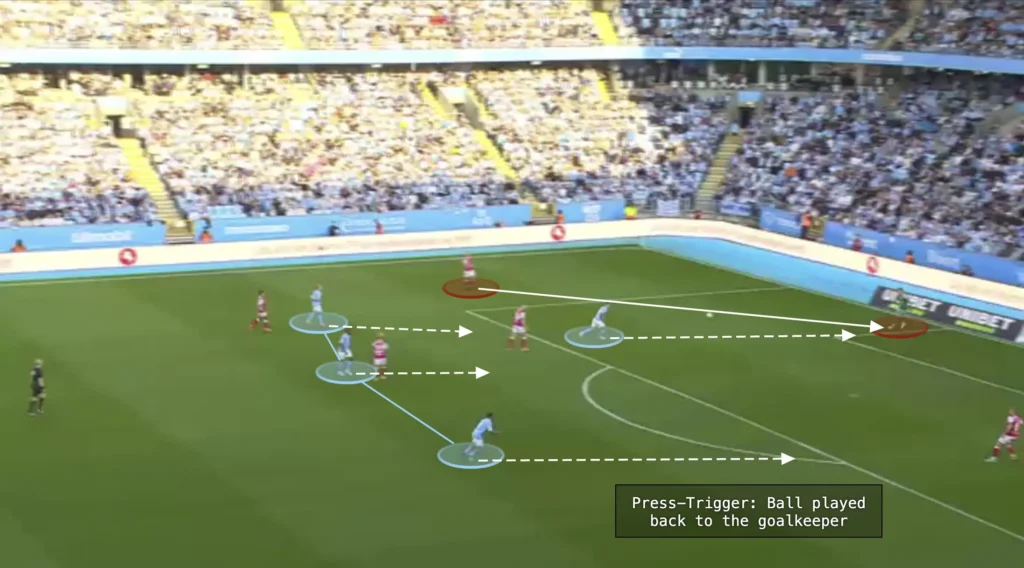
The fundamental objective of a high-press system is to deny opposing defenders the time and spatial comfort required to build clean, progressive passing sequences from the back. When attacking forwards and advanced midfielders coordinate their pressing triggers—usually targeting a poor first touch or a weak full-back—the player in possession is forced into a state of panic. This acute cognitive and physical pressure drastically limits their passing options, frequently leaving them with no alternative but to execute hurried, low-angled clearances along the floor or directly into the bodies of oncoming pressers.
Because these hurried clearances are executed under intense duress inside the defensive third, they rarely travel long distances or find open teammates in midfield. Instead, the ball frequently ricochets off blocking attackers, hits overlapping defenders who are tracking back, or is deliberately driven out of bounds by a panicked backline looking to reset their defensive shape. This specific sequence of events means that a high-pressing team will naturally accumulate a high volume of blocks, deflections, and wide out-of-bounds balls, all of which directly accelerate the match’s corner kick cadence.
The Operational Link Between High Attacking Velocity and Set-Piece Outcomes
When a high-press successfully forces a turnover within thirty to forty yards of the opponent’s goal, the transition from defense to attack occurs with immense speed. Because the opponent’s defensive block was expanding to initiate their own buildup prior to losing the ball, their central defenders are completely disorganized and out of position. The pressing team immediately exploits these vacated interior spaces, flooding the penalty box with multiple runners and forcing rapid, low-composure tracking movements from the recovering defenders.
To neutralize these immediate, high-velocity attacking threats, central defenders are forced to throw themselves into last-second slide tackles or block crossing lanes blindly. When an attacker delivers a rapid cutback or a low cross from an advanced wide position under these chaotic conditions, the recovering defender rarely has the bodily control to direct their clearance upfield. The most reliable, low-risk defensive mechanical response in that micro-second is to intentionally divert the ball over their own goal line, choosing to concede a corner kick rather than allowing a high-probability shot from central areas.
Deconstructing the 2011/2012 High-Pressing and Corner Metrics
To fully appreciate the validity of this tactical link, we must analyze the specific performance data generated by the division’s most aggressive attacking units during the 2011/2012 campaign. The historical breakdown below highlights how clubs that maintained an aggressive, territorial presence in the final third translated their high-volume attacking style into clear, measurable dominance across the corner kick and shot statistics.
| Football Club | Average Possession % | Total Shots Attempted | Total Corner Kicks | Average Corners Per Match |
| Liverpool | 55.3% | 633 | 269 | 7.08 |
| Manchester City | 58.1% | 738 | 267 | 7.03 |
| Tottenham Hotspur | 56.2% | 671 | 258 | 6.79 |
| Manchester United | 56.4% | 622 | 234 | 6.16 |
| Chelsea | 54.8% | 614 | 224 | 5.89 |
This dataset reveals a crucial analytical reality: Liverpool and Manchester City were the absolute gold standards for corner generation, comfortably averaging over seven corner kicks per match. In Liverpool’s case, their incredible set-piece volume was heavily driven by wide players like Stewart Downing and Luis Suárez constantly trapping opposing full-backs deep in their corners, leading to a relentless stream of blocked crosses. For analytical operators, this proof demonstrates that targeting the individual corner counts of these high-velocity pressing units was a far safer, lower-variance strategy than predicting their actual match finishing efficiency.
Examining Distinct Structural Paths to High Corner Yields
The Sustained Territorial Squeeze Mechanism
Manchester City under Roberto Mancini achieved their high corner counts by establishing a continuous, choking possession squeeze in the final third. By using advanced interior midfielders like David Silva and Samir Nasri to constantly recycle loose balls immediately outside the box, they kept opposing defenses pinned inside their own penalty area, leading to an inevitable buildup of deflected shots and cleared crosses over ninety minutes.
The Direct Wing-Isolation Model
Tottenham Hotspur utilized an entirely different mechanical approach to corner generation, relying on the blistering transitional speed of Gareth Bale and Aaron Lennon on the flanks. When high turnovers were secured in midfield, the ball was immediately funneled wide to these isolated wingers, whose rapid, low deliveries into the six-yard box left panicked full-backs with no option but to consistently slide the ball behind the goal line.
Leveraging Tactical Pressing Triggers for In-Play Derivative Execution
Isolating these specific high-pressing architectures gives an analytical operator a major advantage when navigating the in-play derivative markets, specifically when tracking live corner lines. When a high-pressing team faces a resilient, well-drilled low-block that refuses to break down centrally, the match will naturally become heavily weighted toward wide deflections and shot attempts from distance. If the favorite fails to score early, their pressing intensity will naturally spike in the second half as they chase a breakthrough, dramatically accelerating the rate of corner generation.
Situational Parameters for Accurate Corner Accumulation Forecasts
- Identify Deep Defending Visual Cues: Watch for opposing center-backs consistently dropping deeper than the eighteen-yard line to defend spaces, which increases cross deflections.
- Track Progressive Full-Back Heatmaps: High corner counts are highly probable when both attacking full-backs are permanently operating past the half-way line.
- Monitor Passing Accuracy Under Pressure: A rapid decline in the defending team’s passing accuracy inside their own half signals an imminent wave of panicked clearances over the line.
When an analyst observes these live indicators and notices that an elite pressing favorite is aggressively suffocating an opponent’s buildup without finding a clinical breakthrough, the derivative lines become highly predictable. Observing a prolonged period of final-third dominance followed by immediate position taking on a fluid online betting site like ufa168 สล็อต allows savvy market participants to secure high-value over-lines on corners before bookmaker algorithms adjust to the true attacking velocity.
Structural Constraints That Neutralize Pressing and Set-Piece Cadence
While the link between high-pressing and corner generation is incredibly robust, the strategy faces sharp failure cases when specific tactical or structural boundaries are crossed. The most significant threat to a team’s pressing efficiency is physiological fatigue, particularly during the dense winter fixture blocks where the squad’s physical output naturally drops. If a high-pressing team lacks the energy to maintain a coordinated, synchronized press, their lines become fractured, allowing the opposition to easily pass through the initial press and play the game in the middle third of the pitch.
Mechanism of Pressing Deconstruction
The Long-Ball Press Bypasses
If an opposing manager instructs their goalkeeper and defenders to completely abandon short buildups and instead launch direct, high-lofted balls over the pressing lines into a target man, the high-press is rendered entirely useless. This tactical adjustment completely eliminates the risk of final-third turnovers, drastically reducing the volume of blocked clearances and wide deflections that typically drive the pressing team’s corner statistics.
Central Pitch Stagnation
When a pressing team is forced to play on a badly degraded, waterlogged pitch, the speed of horizontal ball movement drops significantly, allowing the defensive unit ample time to slide across and cover spaces without needing to make desperate, sliding interventions. This reduction in defensive panic directly suppresses the number of mistakes, resulting in a low-tempo, central affair where corner volumes fall well below seasonal averages.
Navigating Highly Efficient Fixture Lists via Controlled Digital Alternatives
On weekends when the Premier League schedule features matches between highly conservative, non-pressing sides that specialize in central stagnation, the mathematical value within the sports derivative markets completely dries up. Forcing a corner position under these sub-optimal analytical conditions introduces unnecessary risk into a bankroll management model. When the live sports markets lack clear, high-variance edges, transitioning capital toward a premium, licensed casino online website provides a highly structured alternative for consistent risk management. Within these digital ecosystems, operators can engage with algorithmic card games or live-dealer tables where the underlying probability matrices are entirely fixed, transparent, and completely insulated from human elements like player fatigue or bad weather. This strategic pivot ensures that an analyst’s volume of weekly positions remains steady without being forced to wager on football lines that lack an objective tactical foundation.
Summary
The 2011/2012 Premier League campaign offered definitive proof that aggressive high-pressing systems are the primary engine behind elite corner kick and shot generation statistics. Teams like Manchester City and Liverpool demonstrated that pinning an opponent deep inside their own territory forces a predictable loop of panicked clearances and deflected crosses that naturally drives up set-piece counts. To protect profit margins, analytical operators must accurately monitor changes in pressing intensity, identify tactical long-ball counters that bypass pressing traps, and remain fully prepared to reallocate their capital to fixed-probability digital environments whenever the live sports board fails to present a clear tactical advantage.